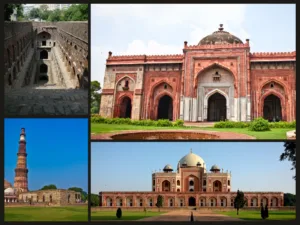
Mehrauli Archaeological Park stands today as one of Delhi’s most fascinating heritage zones, and it continues to attract visitors who want to explore more than 1,000 years of history. Although the city around it has transformed, this large historical landscape remains a calm and meaningful reminder of Delhi’s past.
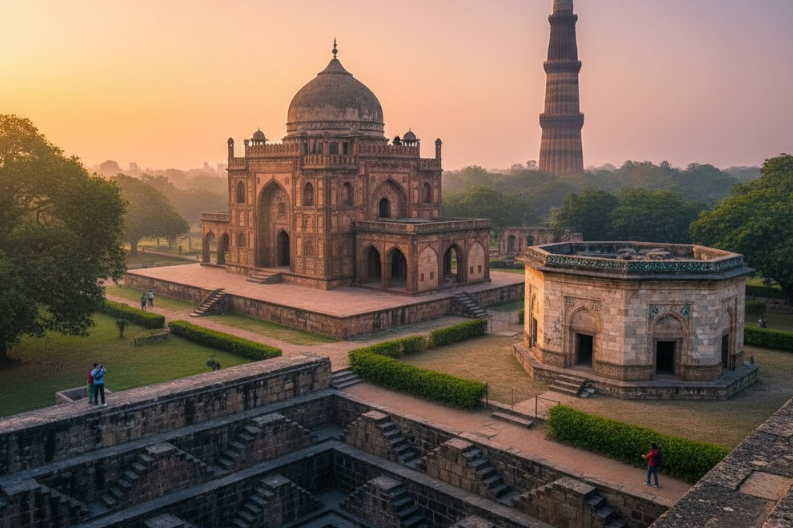
Spread across 200 acres, the park holds over 100 monuments, making it one of India’s richest archaeological areas. It sits right beside the iconic Qutub Minar, and as a result, many travellers visit both sites in a single trip. Even though the city is busy outside, the moment you enter the park, the atmosphere changes into one filled with old stones, ancient paths, and stories of forgotten rulers.
Moreover, Mehrauli is known as one of the seven ancient cities of Delhi, along with Siri, Tughlaqabad, and Shahjahanabad. Each corner of the park offers something new, from tombs, stepwells, and mosques to ruins from the Tomar, Khalji, Tughlaq, Lodi, Mughal, and British periods. Because of this long historical timeline, Mehrauli is considered the only area in Delhi with continuous settlement for 1,000 years.
Although many structures are centuries old, the site has been carefully preserved over the years. Conservation efforts began in 1997 through a partnership between INTACH, Delhi Tourism, DDA, and the State Archaeology Department. Since then, around 40 monuments have been restored, and new signboards, trails, and pathways have been added to help visitors move around easily.
To give readers a clearer picture, here is a quick overview of the site’s major features:
| Feature | Details |
|---|---|
| Total Area | 200 acres |
| Number of Monuments | 100+ |
| Historical Timeline | Tomar to the British era |
| Restoration | 40 structures restored by INTACH |
| Location | Beside Qutub Minar, South Delhi |
| Entry Fee | Free |
| Unique Feature | 1,000 years of continuous occupation |
Although many monuments stand out, some have become favourites among tourists because of their design, legends, and unusual history.
Important Heritage Spots Inside the Park
1. Jamali-Kamali Mosque and Tomb
Built in the early 1500s, this site remains one of the most attractive structures inside the park. The mosque has five arches decorated with red sandstone patterns, while the tomb beside it contains two graves: Jamali, a celebrated Sufi poet, and the mysterious Kamali, whose identity is still unknown. Additionally, the inside walls include beautifully inscribed verses, which make the interior more interesting.
2. Rajon ki Baoli (Stepwell)
This three-storey stepwell from the Lodi era shows how people stored water in medieval India. Although the water has dried up now, the deep stone steps and cool chambers still amaze visitors. Because stepwells were designed to offer both utility and beauty, Rajon ki Baoli remains one of the park’s most photogenic sites.
3. Tomb of Quli Khan
Muhammad Quli Khan, the foster brother of Emperor Akbar, rests here. His tomb originally had colourful glazed tiles in blue and green, and even today, the structure stands out because of its octagonal exterior and square interior. In the 1830s, Sir Thomas Metcalfe, a British official, converted the tomb into a pleasure retreat called Dilkhusha, meaning delight of the heart. The surrounding gardens, water channels, and pavilions added a new layer of charm.
4. Balban’s Tomb
This 13th-century structure is famous because it contains the first true arch found in Indo-Islamic architecture. This makes the site extremely important for students of history and architecture.
5. Metcalfe’s Folly and Houses
Spread across the park are structures built or modified by Thomas Metcalfe. These include watchtowers, guesthouses, and garden pavilions created during the British era. They reveal how colonial officers enjoyed the scenic views of old Delhi.
Historical Significance and Extra Insights
Although the park is full of monuments, it also has natural beauty. Visitors often see butterflies, birds, peacocks, and sometimes even wild boars and monkeys. Because the park mixes nature with history, it has become a favourite place for morning walkers, photographers, and heritage explorers.
Furthermore, the area includes the ruins of Lal Kot, Delhi’s oldest surviving fort wall, built by the Tomar Rajputs around 1060 CE. These broken walls mark the foundation of the earliest Delhi kingdom and show how the city expanded over centuries.
Although tourists now visit the park in large numbers, local communities have always been closely connected with its shrines and Sufi dargahs. This mix of religion, architecture, and local culture creates a unique environment that is not usually found in other Indian heritage parks.
Additionally, the recent G20 Summit in Delhi led to renewed beautification efforts. Several pathways were cleaned, gardens improved, and lighting enhanced so that more people could safely explore the monuments throughout the day.
Who Should Visit and Why?
Travellers who enjoy history, photography, nature walks, or calm relaxation will find Mehrauli ideal. Students and researchers often come here to study early Delhi architecture. Families can take long walks and learn about ancient structures. Since entry is free, it also becomes a good option for budget tourists who still want to see world-class heritage.
Key highlights for visitors:
- More than 1,000 years of history
- More than 100 monuments in one place
- Free entry
- Close to the Qutub Minar metro station
- Large open green spaces
- Perfect for heritage walks
As heritage tourism continues to grow, Mehrauli Archaeological Park stands ready to welcome more visitors who want to understand the deep cultural layers of Delhi. Because the site combines history, architecture, storytelling, and nature, it remains one of the capital’s most enriching experiences.
Although Delhi has many historical places, few offer the same depth and diversity found here. Therefore, anyone visiting the national capital should take time to walk through its ruins and explore the stories hidden between the stones. In every direction, there is something ancient waiting to be discovered, making Mehrauli Archaeological Park a timeless treasure for all.