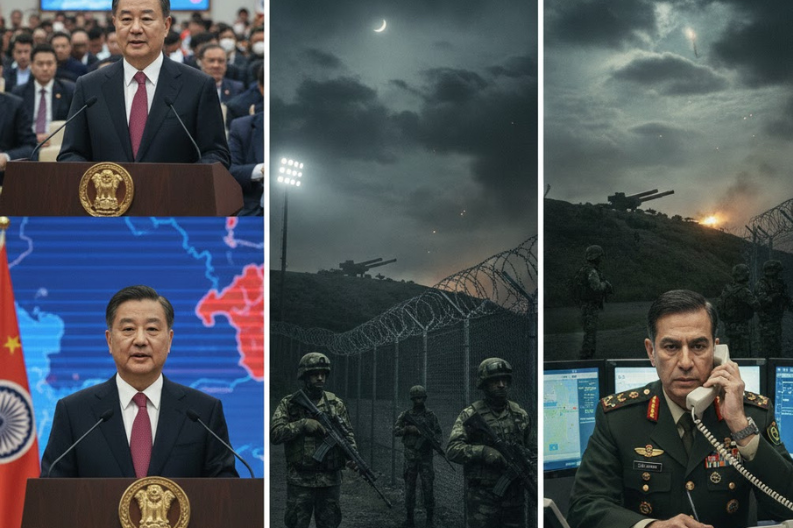
India has strongly rejected China’s India-Pak Truce Claim following Beijing’s assertion that it mediated peace between India and Pakistan during the May 2025 military conflict. Chinese Foreign Minister Wang Yi made this claim at a symposium in Beijing, echoing similar statements made earlier by US President Donald Trump.
However, New Delhi maintains that Pakistan requested the ceasefire directly. Furthermore, Indian government sources clarified that the truce came through direct talks between the Director Generals of Military Operations (DGMOs) of both countries.
India’s Official Position
| Key Point | India’s Stand |
|---|---|
| Mediation | No third-party mediation took place |
| Ceasefire Request | Pakistan requested India’s DGMO for truce |
| Resolution Date | May 10, 2025, at 15:35 hours |
| DGMO Talks | Direct phone call between both countries |
“India’s position on mediation has always been clear. There was no mediation that took place after Operation Sindoor. Pakistan requested India’s DGMO for a ceasefire,” sources told media outlets.
What China Claimed
Wang Yi claimed that China mediated several global conflicts this year, including tensions between India and Pakistan. Additionally, he listed northern Myanmar, the Iranian nuclear issue, Palestine-Israel tensions, and the Cambodia-Thailand conflict as areas where Beijing played a mediating role.
“Following this Chinese approach to settling hotspot issues, we mediated in northern Myanmar, the Iranian nuclear issue, the tensions between Pakistan and India, the issues between Palestine and Israel, and the recent conflict between Cambodia and Thailand,” Wang Yi stated.
Moreover, he emphasized that local wars and cross-border conflicts increased more than any time since World War II ended.
Operation Sindoor Conflict Details
Timeline:
- May 7, 2025: India launched Operation Sindoor following the Pahalgam terrorist attack
- May 10, 2025: Ceasefire agreed through DGMO phone call at 15:35 hours
- May 13, 2025: Ministry of External Affairs confirmed direct bilateral resolution
China’s diplomatic response on May 7 expressed regret over India’s airstrikes. Nevertheless, Beijing called on both nuclear-powered nations to exercise restraint. The Chinese Foreign Ministry statement said, “China finds India’s military operation early this morning regrettable.”
China’s Military Support to Pakistan
China’s role during Operation Sindoor faced serious criticism, especially regarding military assistance provided to Islamabad. A US-China Economic and Security Review Commission report claimed Beijing used the conflict to test and promote its defense capabilities.
The report stated that China’s modern weapons systems, including the HQ-9 air defense system, PL-15 air-to-air missiles, and J-10 fighter aircraft, were used in active combat for the first time. Therefore, the conflict served as a real-world field experiment for Chinese military technology.
Furthermore, China reportedly offered Pakistan 40 J-35 fifth-generation fighter jets, KJ-500 aircraft, and ballistic missile defense systems in June. Chinese embassies praised the “successes” of its weapons systems to boost weapons sales.
Indian Military’s Assessment
Lt General Rahul R Singh, Deputy Chief of Army Staff, stated that China’s strategy during Operation Sindoor followed its ancient “36 stratagems” military philosophy. He emphasized that Beijing extended all possible support to Pakistan to cause pain to India.
Additionally, China’s arms exports account for over 81% of Pakistan’s military hardware, highlighting the deep defense cooperation between Beijing and Islamabad.
Wang Yi’s Other Statements
Besides the India-Pak Truce Claim, Wang Yi spoke positively about the improvement of China-India relations improvement. He mentioned Prime Minister Narendra Modi’s invitation to the Shanghai Cooperation Organisation summit in Tianjin in August 2025. However, India continues to maintain that bilateral issues require no third-party intervention, reinforcing its consistent diplomatic position.