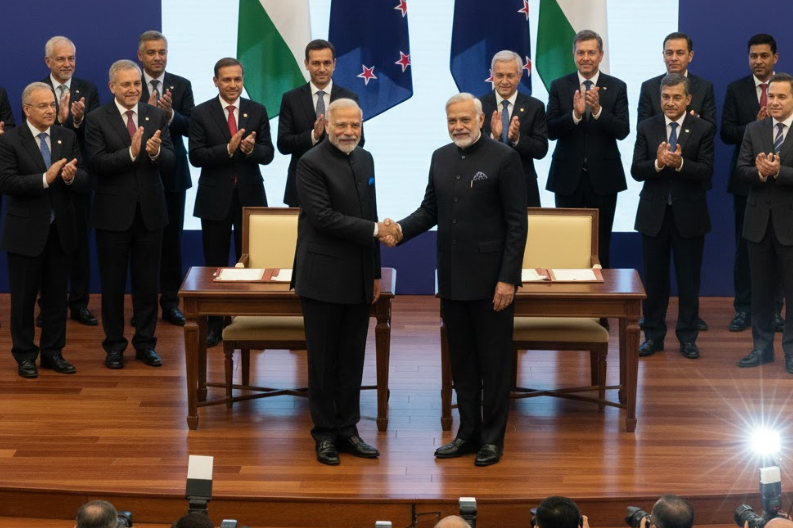
Prime Minister Narendra Modi announced the conclusion of the India-New Zealand free trade agreement on Monday, December 22, 2024. This marks India’s third major trade deal in 2024, following agreements with the United Kingdom in July and Oman on December 18.
Quick Timeline
The two countries moved remarkably fast on this agreement. They launched FTA discussions on March 16, 2024, during New Zealand Prime Minister Christopher Luxon’s five-day visit to India. Subsequently, both sides completed four formal rounds of negotiations within just nine months.
The final round took place in Rotorua, New Zealand, in November 2024. Union Commerce Minister Piyush Goyal led India’s delegation during this crucial meeting. Moreover, New Zealand’s Trade Minister Todd McClay visited New Delhi on December 12 to finalize remaining details.
Key Benefits for Both Countries
For New Zealand Exports
The agreement eliminates or reduces tariffs on 95% of New Zealand’s exports to India. Furthermore, more than half of these products will become duty-free immediately when the pact takes effect. This gives New Zealand companies easier access to India’s rapidly growing middle class.
For Indian Exports
India offered tariff liberalization covering 70% of product lines, which represents 95% of New Zealand-India bilateral trade. Additionally, Indian exporters gain better market access for organic products, pharmaceuticals, and professional services.
Investment and Jobs
| Benefit | Details |
|---|---|
| New Zealand Investment | $20 billion pledge to India |
| Work Visas for Indians | 1,667 annual temporary work visas |
| Working Holiday Visas | 1,000 additional places per year |
| Target Sectors | Doctors, nurses, teachers, IT professionals, engineers |
| Duty-Free Products | Over 50% immediate, 95% eventually |
Protected Sectors
India will continue protecting its subsistence farmers and dairy sector from competition. However, the country may offer concessions on non-competing items like kiwi fruits and timber. Similarly, both sides agreed to respect each other’s sensitive sectors while maximizing mutual benefits.
Trade Growth Potential
Current bilateral trade between India and New Zealand stands at $1.3 billion for 2024-25, showing nearly 49% year-on-year growth. The agreement is expected to unlock further potential in several key sectors:
- Agriculture and food processing
- Renewable energy
- Pharmaceuticals
- Education services
- Technology and digital payments
Moreover, the deal aims to enhance supply chain integration between the two countries. This will help Indian exporters diversify their markets and reduce dependence on any single geography.
Timeline for Implementation
Both governments expect to sign the final agreement in the first half of 2026. Meanwhile, a draft agreement is ready and awaits legal review and translation. Nevertheless, the deal still needs parliamentary approval in both countries.
Interestingly, New Zealand First party, which holds eight seats in New Zealand’s 123-seat parliament, has already announced it will vote against the deal. Despite this opposition, the agreement has strong support from the governing National Party.
Economic Impact
New Zealand Prime Minister Christopher Luxon called the gains “wide-ranging and significant.” He emphasized that India’s status as the world’s most populous country and fastest-growing major economy creates tremendous opportunities. By 2030, experts forecast India’s economy will reach NZ$12 trillion ($7 trillion).
The India-New Zealand free trade agreement represents a comprehensive and balanced approach that ensures mutual gains while respecting both countries’ sensitivities. This deal strengthens bilateral ties and creates new opportunities for businesses and consumers alike.