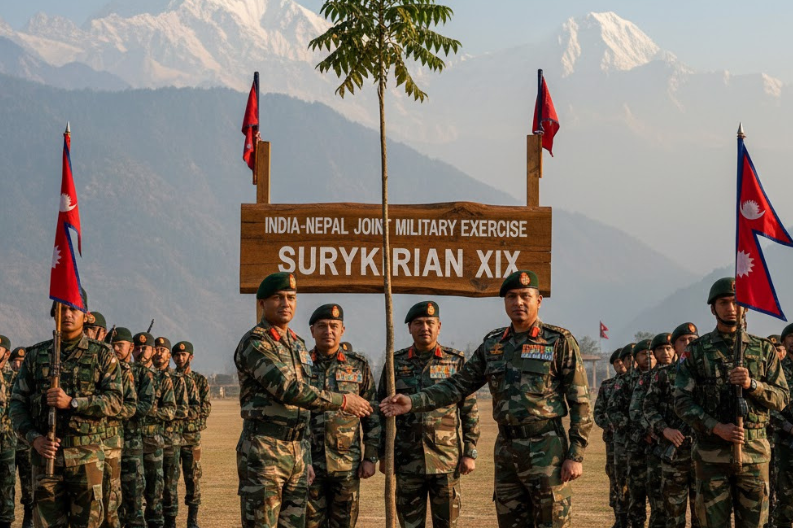
India-Nepal culminate 19th edition of Exercise Suryakiran with a successful closing ceremony at Pithoragarh, Uttarakhand on Tuesday. Moreover, the Directors General of Military Operations (DGMOs) from both countries jointly witnessed the final validation exercise. Specifically, this intensive two-day battalion-level wargame showcased exceptional military cooperation. Consequently, the event strengthened the strategic partnership between the two Himalayan neighbors.
The DGMOs of both armies planted a Tree of Friendship during the closing ceremony. This symbolic gesture represents the enduring brotherhood between India and Nepal. Furthermore, Lt. General Manish Luthra from the Indian Army and General Anup Jung Thapa from the Nepal Army participated in this meaningful tradition. Therefore, the ceremony highlighted decades of military cooperation and mutual trust.
Exercise Participation Details
Both nations contributed equal strength to this joint military exercise. Each side deployed 334 personnel for comprehensive training operations.
| Country | Regiment | Personnel |
|---|---|---|
| India | ASSAM Regiment | 334 troops |
| Nepal | DEVI DATTA Regiment | 334 troops |
| Total | Both Forces | 668 troops |
Training Focus and Objectives
The exercise focused primarily on counter-terrorism operations in mountainous terrain. Additionally, troops trained extensively in jungle warfare tactics. Meanwhile, both armies practiced operations under Chapter VII of the United Nations Mandate, which covers enforcement actions.
Key Training Areas:
- Intelligence-led surgical operations
- Aerial insertion techniques in complex terrain
- Coordinated battalion-level operations
- Company and small-team tactical maneuvers
- Rapid-response capability enhancement
- Sub-conventional warfare methods
Advanced Technology Integration
The validation exercise showcased cutting-edge military technologies. First, troops used intelligence, surveillance, and reconnaissance (ISR) drones for battlefield awareness. Similarly, precision-targeting drones enhanced operational accuracy. Furthermore, soldiers employed advanced weapon sights for both day and night operations.
Technologies Demonstrated:
- AI-enabled surveillance feeds
- Unmanned operational platforms
- Unmanned logistics platforms
- Secure battlefield communication systems
- Advanced targeting systems
- Real-time intelligence sharing networks
Operational Success Highlights
The exercise demonstrated seamless interoperability between both armies. Specifically, forces executed synchronized mission planning across multiple operational levels. Moreover, troops showcased coordinated execution under realistic combat conditions. Therefore, the validation proved both nations can operate effectively together during crisis situations.
The Indian Army praised the high degree of operational synergy achieved during training. Additionally, officials noted the strengthened mutual trust between military personnel. Consequently, this exercise reinforces regional stability and peace in the strategic Himalayan region.
Strategic Importance: Exercise Suryakiran plays a crucial role in maintaining security cooperation. The Himalayan region requires constant military readiness and coordination. Furthermore, joint exercises ensure both nations can respond effectively to terrorism threats. Meanwhile, these operations build lasting personal relationships between soldiers from both countries.
The training emphasized intelligence-driven operations in difficult terrain. Moreover, aerial insertion drills prepared troops for rapid deployment scenarios. Therefore, both armies gained valuable experience working together in challenging mountain environments.
This successful exercise strengthens the long-standing military partnership between neighboring nations. Both countries remain committed to continuing regular joint training operations. Additionally, future exercises will likely incorporate even more advanced technologies.
India-Nepal culminate 19th edition of Exercise Suryakiran, demonstrates how bilateral military cooperation enhances regional security while building lasting strategic partnerships through shared training and mutual respect.