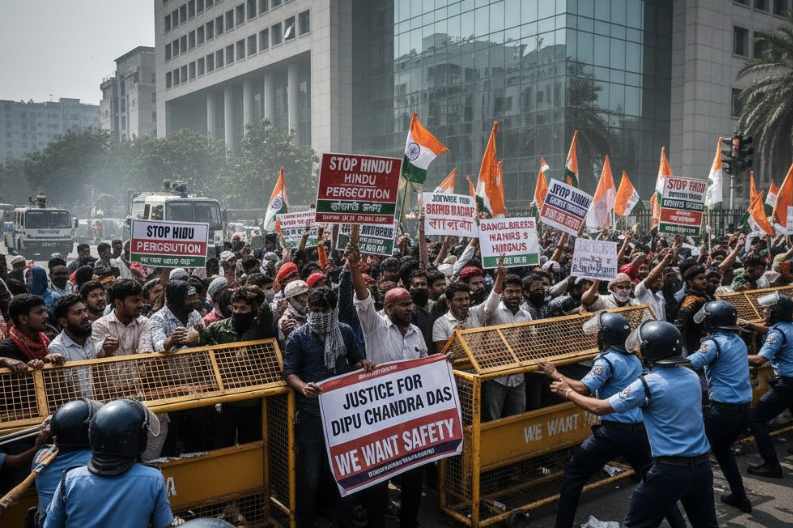
Protests At Bangladesh missions erupted across India after the brutal lynching of Dipu Chandra Das, a 25-year-old Hindu man, in Mymensingh on December 19. The Vishwa Hindu Parishad (VHP) and Bajrang Dal led massive demonstrations outside the Bangladesh High Commission in New Delhi. Moreover, similar protests occurred in Kolkata and Siliguri, prompting both nations to summon each other’s diplomatic envoys.
Delhi Police deployed heavy security outside the High Commission with three layers of barricading. However, protesters managed to breach at least two barricade layers. Furthermore, security forces resorted to lathi-charge to control the situation. Several demonstrators carried banners and placards while raising slogans against alleged atrocities on Hindus in Bangladesh.
Emotions are high we can’t guarantee Bangladesh High commission security today.
From sealdah station MARCH TO BANGLADESH HIGH COMMISSION.@WarLord709 @TridentxIN @NarendraVictory #SaveBangladeshiHindus pic.twitter.com/KtqCsUeCxw— War Monitor (@Tracking_Live) December 23, 2025
Timeline of Recent Events:
| Date | Event |
|---|---|
| December 12 | Sharif Osman Hadi shot by unidentified gunmen |
| December 18 | Hadi dies during treatment in Singapore |
| December 19 | Dipu Chandra Das lynched in Mymensingh |
| December 20 | Protests begin outside Bangladesh missions |
| December 22 | Bangladesh suspends visa operations |
| December 23 | UN voices concern over violence |
Dipu Chandra Das worked at a garment factory when an Islamist mob attacked him over alleged blasphemy charges. Consequently, authorities arrested at least 12 people for their involvement in the murder. The incident sparked international outrage, with UN Secretary-General Antonio Guterres expressing deep concern. “Yes, we’re very concerned about the violence that we’ve seen in Bangladesh,” his spokesperson Stéphane Dujarric stated.
West Bengal Leader of Opposition Suvendu Adhikari and Congress leaders joined protests outside the Bangladesh Deputy High Commission in Kolkata. Additionally, US lawmakers condemned the targeted killing. Congressman Raja Krishnamoorthi called on Bangladeshi authorities to ensure accountability and protect religious minorities. Similarly, New York State Assemblywoman Jenifer Rajkumar expressed being “deeply disturbed” by the ongoing violence.
Diplomatic Actions Taken:
- Bangladesh summoned Indian envoy over mission security
- India summoned Bangladesh High Commissioner earlier
- Both countries suspended visa operations
- Security increased at all diplomatic establishments
Bangladesh suspended visa services in Delhi, Siliguri, and Tripura, citing the “prevailing security situation.” Meanwhile, India had already closed its visa application centers in Bangladesh after mobs targeted them following Hadi’s death. The Bangladesh Foreign Ministry condemned what it called “premeditated violence” against diplomatic establishments.
Relations between the two nations have deteriorated significantly since former Prime Minister Sheikh Hasina’s exile in India. Last month, a Bangladeshi court sentenced her to death for involvement in deadly violence during 2024’s student-led uprising. Subsequently, Bangladesh requested India hand over the “fugitive” former PM, but India refused.
Tensions escalated further after National Citizen Party leader Hasnat Abdullah made controversial statements. He suggested Bangladesh could shelter Indian separatist forces and sever India’s seven northeastern states. This speech prompted India to summon Bangladesh’s high commissioner and register a strong protest.
Bangladesh Law Adviser Asif Nazrul announced that Hadi’s murder case will be tried under the Speedy Trial Tribunal. Additionally, Home Adviser Lt Gen Jahangir Alam Chowdhury confirmed progress in the investigation. Authorities actively search for the main accused, Faisal Karim Masud.
Protests At Bangladesh missions continue as both nations struggle to manage rising tensions. The situation remains volatile, with both governments calling for protection of diplomatic establishments while addressing domestic pressures and international scrutiny.